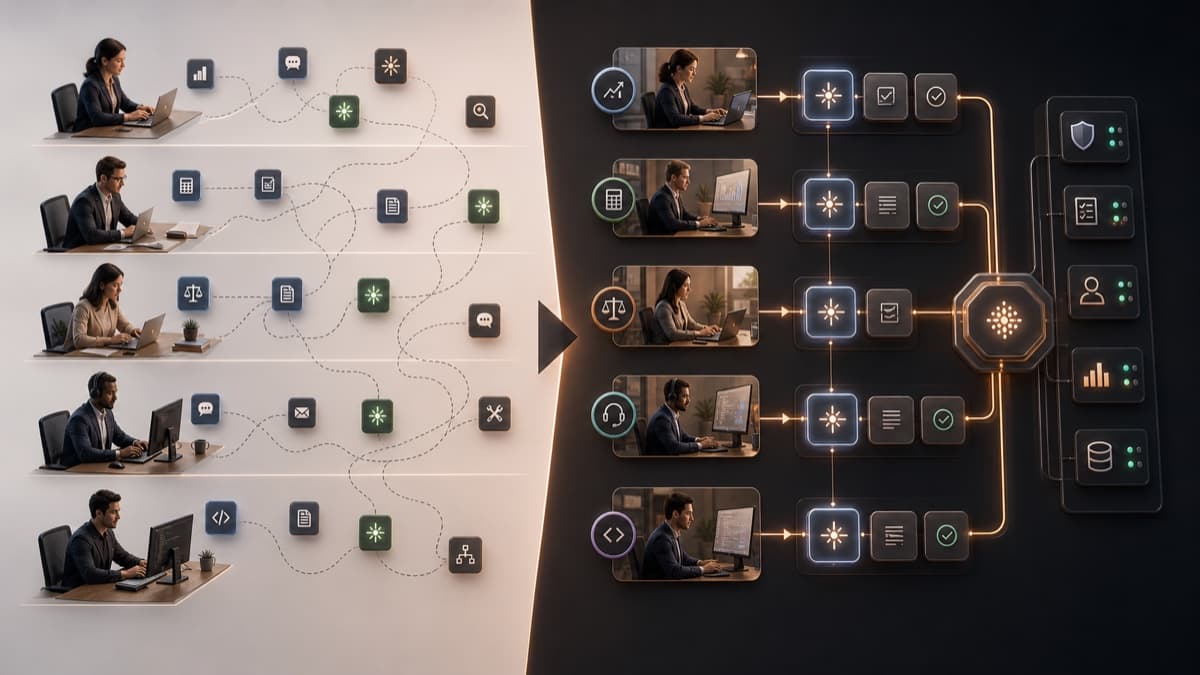
The enterprise AI adoption question has changed. The issue is no longer whether employees are using AI. McKinsey's 2025 State of AI research found that AI use is now widespread across organizations. Gallup's 2026 workforce research shows that many employees are using AI at work at least occasionally.
The harder question is whether work has changed. A company can have thousands of AI interactions per week and still run the same slow workflows, handoffs, approvals, reviews, and reporting routines.
Usage is a signal, not the outcome
License activation is not adoption. Chat volume is not transformation. Prompt sharing is not workflow redesign. Those metrics are useful because they show where energy exists, but they do not prove the company is operating differently.
The real adoption metric is workflow depth. Did the AI workflow become a repeated part of the job? Did it reduce cycle time? Did it improve quality? Did managers support it? Did the team stop doing an old step? Did the pattern spread to adjacent groups?
The best workflows usually start as local inventions
One salesperson finds a better way to prepare for renewal calls. One support lead builds a cleaner escalation summary. One recruiter uses AI to turn interview notes into structured feedback. One analyst uses an agent to check variance explanations. These patterns rarely begin as official transformation programs.
That creates a management challenge. The company needs to find the useful local inventions, evaluate their risk and value, package them, and spread them without forcing everyone into a generic training module.
- Measure repeat use by workflow, not just by user.
- Find teams where AI activity correlates with better operating outcomes.
- Identify champions whose workflows are spreading informally.
- Retire low-value pilots before they consume enablement capacity.
- Convert proven patterns into templates, guidance, and budget.
Proxon turns adoption into an operating record. It shows which teams are using AI deeply, which workflows are changing, which owners are accountable, which patterns are producing value, and where adoption is shallow or risky.
AI usage is the raw material. Workflow redesign is the business result. Companies that manage that conversion deliberately will get more value from the same tools than competitors who only count seats and messages.