
Walk into almost any company today and the org chart still looks familiar: CEOs, VPs, directors, managers, and individual contributors.
But that’s no longer how work actually gets done.
Across engineering, sales, marketing, finance, legal, and support, people are quietly assembling teams of AI around themselves. Work that once required hours of individual effort is now delegated to a collection of models, agents, and workflows. The employee’s role is changing from doing the work to directing it: assigning tasks, reviewing output, providing feedback, and deciding what happens next. Every employee using AI has become a manager.
In other words, everyone just got promoted.
That simple idea is why we started Proxon.
For decades, companies have invested enormous effort into managing people. We built org charts, budgeting systems, performance reviews, hiring processes, compliance programs, approval chains, and accountability structures. Every enterprise management system assumes one thing: the work is done by humans.
That assumption is breaking as workforces become a blend of human and synthetic employees. As AI becomes part of everyday work, more employees will find themselves directing, reviewing, and coordinating AI alongside people. Over time, more work will move from salaries to tokens. Companies won’t just budget for people. They’ll budget for intelligence.
The software to manage that workforce doesn’t exist yet, so we set out to build it.
As we talked to leaders across dozens of organizations, we noticed that although companies weren’t all facing the same AI problems, they were reaching them in the same order.
Companies just getting started with AI asked the same questions. What is actually happening inside our organization? Which AI tools are people using? Who are our power users? Where is adoption taking off, and where is it stalling? Most importantly, how do we move faster?
The next group had already crossed that bridge. AI was everywhere, but the spending had become impossible to understand. Uber burned through its entire 2026 AI budget in four months after rolling out agentic coding tools, and its own COO admitted he couldn't yet draw a line from the spend to anything customers would feel. That story wasn't unusual. In our own conversations, leader after leader described the same thing: large model invoices arriving every month, and almost no one able to explain which teams were creating value, which workflows justified their cost, or where the waste was hiding.
The most advanced companies had moved beyond adoption and spend entirely. They already believed AI worked. Their challenge was management. Engineering had pulled away from the rest of the business after embracing AI, and now they wanted to recreate that velocity in every department. Which workflows should be replicated? Which agents own which outcomes? Where should they invest next? How do you scale what's working instead of hoping every team figures it out on its own?
Those conversations shaped both what we built first and where we’re headed next.
We built Proxon to be the management layer for the AI workforce: a live view of the AI tools, agents, workflows, and costs inside your company. We’re starting with visibility because every company, regardless of maturity, needs to understand what’s happening before it can improve it.
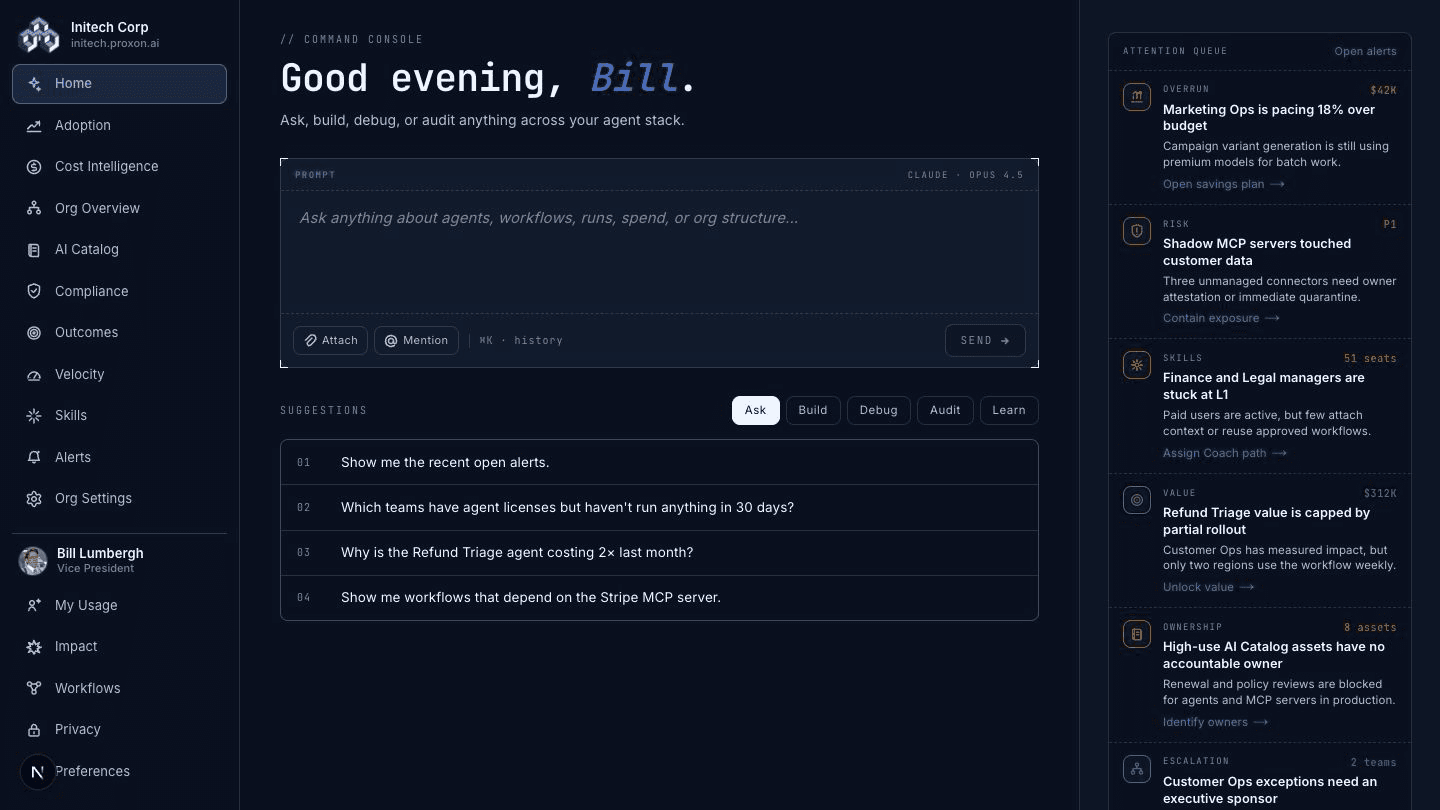
Visibility is just the beginning. As AI adoption increases, visibility becomes cost intelligence. Cost intelligence becomes operational accountability. Eventually, managing AI becomes no different than managing people, budgets, or products. It’s simply another part of running a company well.
Every major shift in enterprise computing created a new category of management software. ERP systems helped companies manage resources. CRM systems helped them manage customers. HR systems helped them manage people. The next generation of companies will manage people and AI together, and that's the system we're building.
We're still early. The technology will change, the models will improve, and new agents will appear almost weekly. None of that changes the underlying direction. Companies are reorganizing around AI, whether they realize it yet or not. The winners won't be the ones with access to the best models. Eventually, everyone will. The winners will be the ones that learn to manage a workforce of human and synthetic employees better than anyone else.
Everyone you work with just got promoted, and companies now need software that helps those new managers succeed.
That's why we built Proxon.