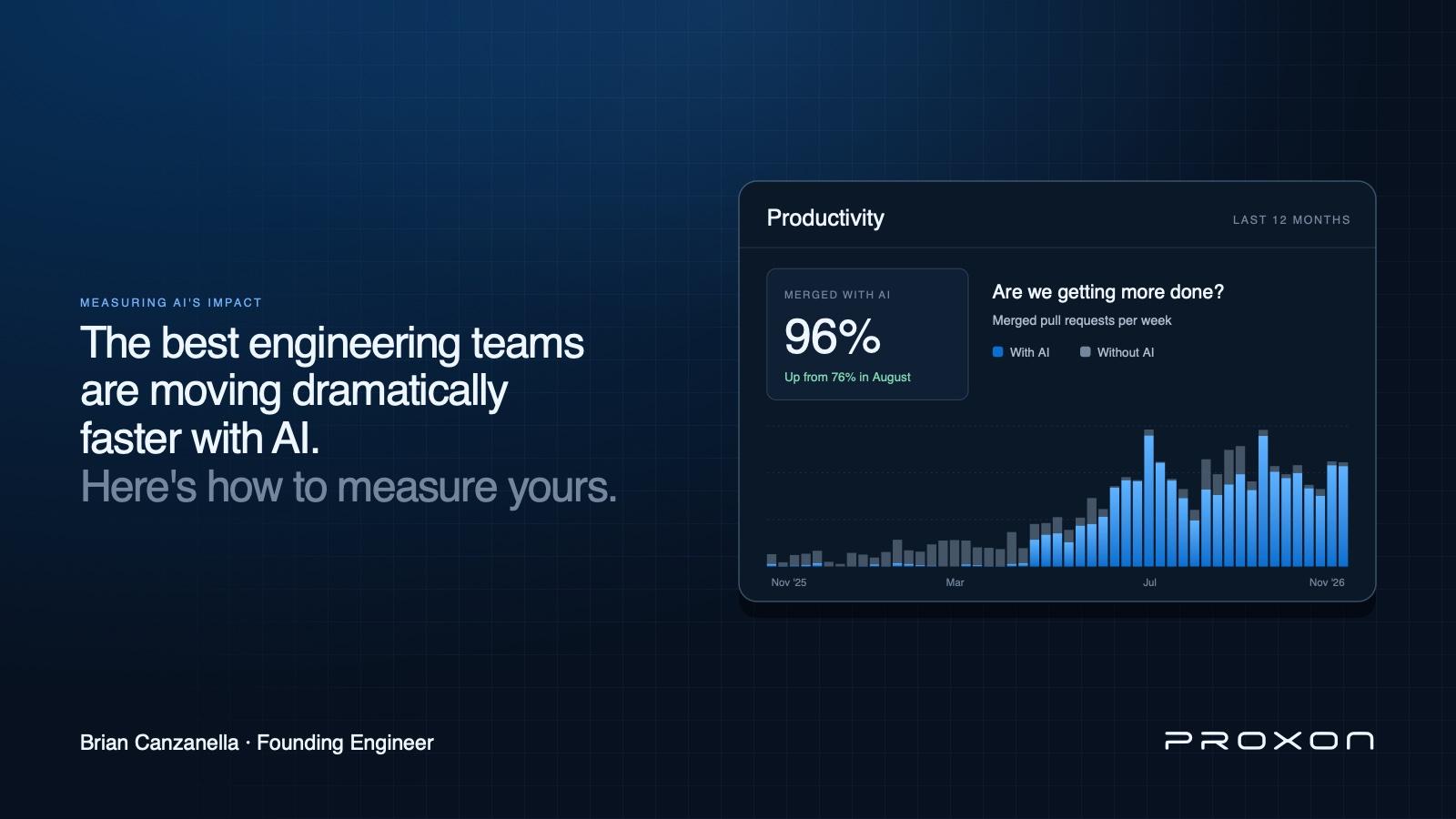
The best engineering teams are moving at a pace that would have sounded made up two years ago.
At OpenAI, three engineers driving Codex merged about 1,500 pull requests in five months, without writing code by hand. Lauren Tan, the engineer behind the open-source agent toolkit pstack, says she ships about 2,000 PRs a month. Our own team writes code about 50x faster than it did a year ago. In one 30-day stretch, our team merged 690 pull requests, a median of 16 minutes apart. (Our CEO wrote up exactly how we do it.)
That gap is the opportunity. The hard part is knowing where your own team sits on it.
The short answer? Look at the work that merged, not at usage. Usage is who has a seat, how many prompts they send and how many tokens they burn. It tells you AI is being used, not what it shipped. Compare AI-assisted and human-only pull requests team by team, check whether that work got reviewed, and use what you learn to decide where to lean in, what to fix and which tools to keep.
Three questions to ask about AI productivity for engineers
| Question | What to measure | What it tells you |
|---|---|---|
| How much more are we getting done? | Cycle time of AI-assisted vs. human-only merged PRs, by team | Where AI fits the work, and where it doesn't yet |
| Where's our next speedup? | Time to first review, PRs merged without review, and reverts and follow-up fixes if you can pull them | Where work is waiting, and what it takes to go faster safely |
| What do we do next with AI? | The first two answers, next to what each tool costs | Where to expand AI, what to fix and which seats to renew |
1. How much more are we getting done?
Start with work that merged, not work that started. Prompts, accepted suggestions and opened PRs are all activity. A merged pull request is about as close as engineering gets to a unit of shipped work.
Then compare PRs written with AI help against PRs written without it, on the same repos over the same window, and see how long each takes from first commit to merge.
Do it by team. An org-wide average hides the most useful part, which is the spread. One team may already be working like the examples above while the team next to it hasn't changed at all. If I'm a manager, my own team is the first place I'd look. Those are the people I know, and the ones I'd ask what's working.
One caveat: this is a comparison, not a controlled experiment. Engineers choose what to hand to AI, so AI-assisted PRs might be smaller or in easier parts of the codebase. Treat a gap as a signal to dig into, and compare within a team where you can. Inline completions and pasted code also leave no trace in a PR, so any AI share you can see is a minimum.
2. Where's our next speedup?
Every time you speed up one stage, the next one becomes your biggest opportunity. When engineers and agents open far more PRs, review, testing and CI are where the next gains are.
The teams furthest ahead say this out loud. Revolut gave its roughly 2,000 engineers unlimited tokens on a self-hosted model. By its own comparison, lead time (from picking up a task to merge) improved about 70%, more than coding time at about 60%. Its AI operations lead put it simply: the bottleneck for engineering is not necessarily coding.
So for every speed number, track what keeps it going:
| If you track… | Also track… | Why |
|---|---|---|
| Cycle time | Time to first review | Faster coding can just mean slower review |
| PRs merged | PRs merged without a human review | Some speed comes from fewer people looking |
| Throughput | Review queue and PR size | More merges can overload reviewers |
| Share of work AI helped write | Reverts and follow-up fixes | Volume says nothing about whether it held up |
If AI work merges faster partly because fewer people look at it, that's your cue to build better safeguards. You don't put brakes on a car to stop; you put them on so you can go faster. The teams moving fastest are the ones that can see when something goes wrong.
3. What do we do next with AI?
Measuring only matters if it changes a decision. The first two answers usually point to four:
- Lean in where it's working. A team where AI-assisted work merges faster and holds up has figured something out. Find out what (the tool, the workflow, the type of work) and spread it.
- Fix the new drag. If review is now the constraint, change how review works: smaller PRs, clear owners, or an independent AI first pass with a human sign-off.
- Look hard at teams that aren't moving. No speedup can mean the wrong tool, missing context, or work AI isn't good at yet. Each needs a different fix.
- Renew with evidence. Before the next renewal, check which tools are used in which repos and how their work holds up.
Before your next AI tool renewal, check:
- Which tools are actually used, and in which repos?
- For each tool, does AI-assisted work merge faster than other work?
- Is that work getting reviewed, and does it hold up after merge?
- What does each tool cost, across seats and usage?
- Which teams aren't seeing a speedup, and why?
Stop flying blind
AI tools and agents are now a real part of the engineering workforce. You wouldn't run a team without knowing what it delivers and where it gets stuck, and the AI doing a growing share of your work is no different.
The teams at the top didn't get there by accident. They measured, found what worked, fixed what didn't, and kept going. A year from now, your team could be the example someone else writes about. The first step is seeing where you are today.
That's why we built Proxon Productivity, which we're launching today. It helps engineering leaders answer a question that matters more every month: how much faster is AI making our engineers, and what return are we getting on what we spend? Connect GitHub or GitLab, with nothing to install on anyone's laptop, and within minutes you see AI-assisted and human work side by side, with six months of history, by team and tool, including how much of it got human review. With Proxon's Cost Intelligence, you see it next to what you spend, so you can tell what's working before the bills grow.
We've made this shift ourselves, and we'll help you make it too. A Proxon expert can work on site with your engineers: take a baseline, train the team on a modern, AI-first way of building software, then hand it off while Proxon keeps measuring. Email hi@proxon.ai to talk to one of our experts.
Want to see where your team stands? Book a demo and we'll walk you through it on your own repos.
FAQ
How do you measure the impact of AI on engineering productivity?
Measure merged pull requests, not token usage. Compare AI-assisted and human-only PRs on cycle time within the same repos and time window, by team. Then check time to first review and how much AI work merges without human review.
What's the difference between AI usage and AI impact?
Usage measures who uses AI tools and how much: seats, prompts, tokens. Impact measures what changed in the work that shipped: how fast it merged, how much review it got and how well it held up. Most teams have usage data. Few have impact data.
What's the next bottleneck after AI speeds up coding?
Usually review. When AI raises the number of PRs, review is where the next speedup is. Watch time to first review and the share of PRs merged without a human review.
How should AI coding tool renewals be decided?
Check which tools are used in which repos, whether their work merges faster and gets reviewed, and what each costs. A tool that's widely used but doesn't speed up shipped work is a candidate to cut.
What is Proxon Productivity?
Proxon Productivity helps engineering leaders see how much faster AI is making their engineers, and what return they're getting on what they spend. It puts AI usage next to what teams ship, by team and tool, and with Proxon's Cost Intelligence, next to what it costs.
About the author
Brian Canzanella is a Founding Engineer at Proxon, where he works on Productivity: how engineering teams see what AI-assisted work actually shipped, and where it gets human review. He has spent about 20 years building software and leading engineers. At New Relic he was a Manager of Software Engineering, leading the team behind the CodeStream IDE extensions for VS Code, JetBrains and Visual Studio. Before that he was a senior engineer at CodeStream (YC W18), and earlier a principal engineer at ion interactive and ScribbleLive. LinkedIn
Research referenced in this post.
- Harness engineering — OpenAI, Feb 11, 2026
- pstack guide, Part 1 — Lauren Tan (self-reported); summarized in The Neuron, Sep 10, 2026
- Shipping like a startup, regulated like a bank — Revolut at AI Engineer NYC
- Revolut moves 2,000 engineers onto self-hosted AI — Dealroom, Nov 3, 2026