
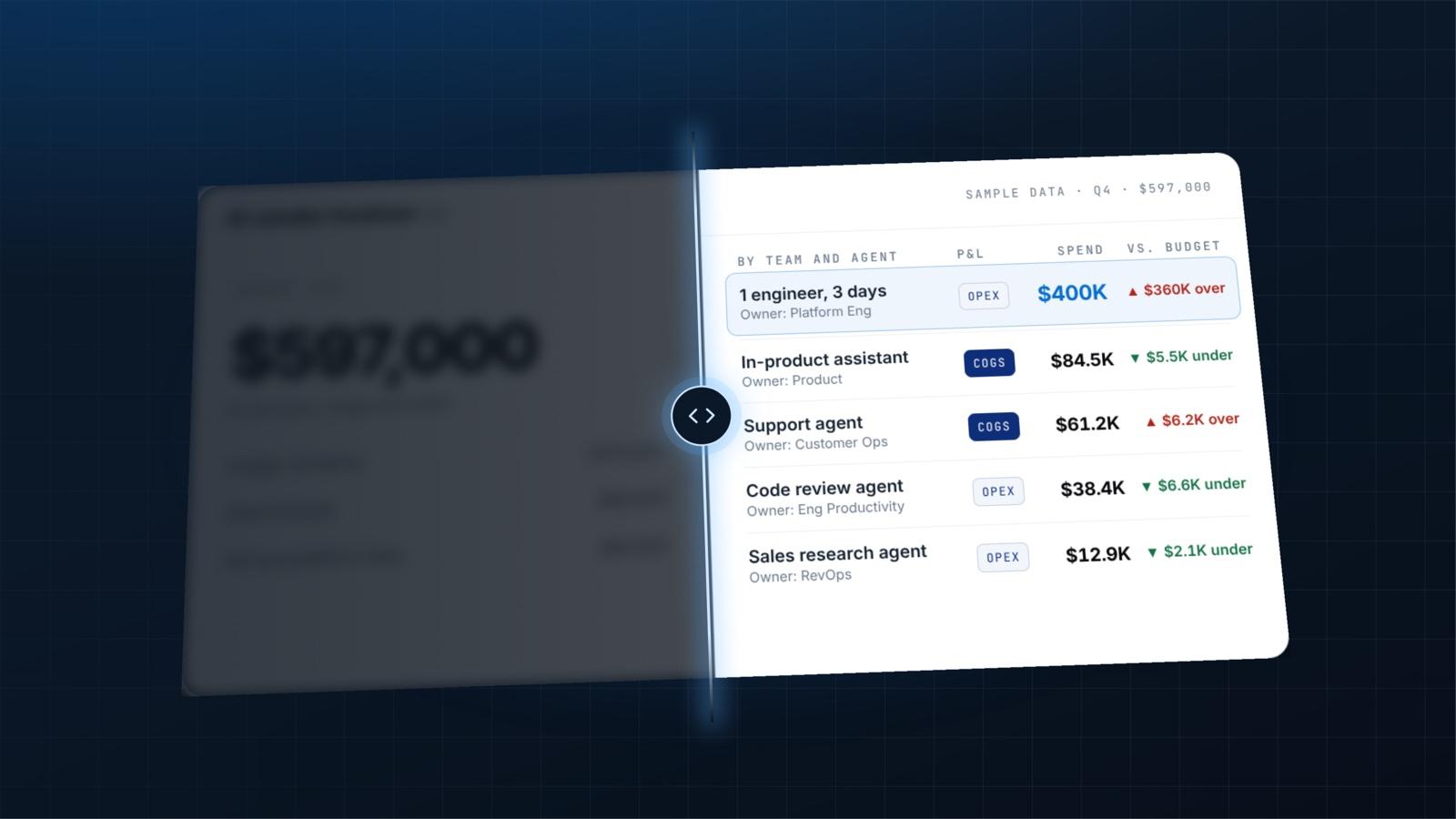
A few months ago, the person who runs AI at a Fortune 100 company reached out to us. One of their engineers had spent $400,000 on AI tokens in three days.
Fire them, or promote them?
You can't answer that from the bill. If the engineer built something that changed the business, it was the best money the company spent all quarter. If it was an experiment that went nowhere, it was a reckless bet. Same invoice, opposite conclusions. It depends entirely on what they delivered.
That's why he called. He had a number and no way to read it. He wanted to know who was doing what, and what the company was getting for the money.
He's not unusual. Once we started talking to executives, we found the same thing everywhere: they're already deploying AI, and they have no idea what's happening.
Every company is going all in on AI. Almost none of them can see it. I call that being AI-blind. The good news is that it's fixable, and the payoff is speed. Once you can see what works, you can put more behind it, faster than everyone who's still guessing.
Take the Test
Five questions. Answer yes or no.
- Can you name your total AI spend for last month, across every vendor?
- Do you know which team spends the most?
- Can you tell the seats people use from the seats people don't?
- Can you point to one use of AI that paid off, and one that didn't?
- Does every AI line have an owner and a budget?
Three or more "no" answers and you are AI-blind. Be honest with yourself on each one.
| Question | AI-blind | AI-clear |
|---|---|---|
| What did we spend on AI last month? | A guess, built from invoices | One number across every vendor |
| Which team spends the most? | Nobody knows | Spend by team and by agent |
| Which seats are used? | Seat count only | Who uses what, and how well |
| What paid off? | Anecdotes | Cost next to results the business already tracks |
| Who owns each line? | Engineering, IT, or finance, depending who you ask | One named owner and a budget per line |
I've Seen This Movie
When I was at New Relic, the cloud made software too complex to understand by reading the code. Nobody could see what their servers were doing, so a whole industry showed up to fix that. It was called observability.
AI is doing the same thing to the company itself. Agents make decisions nobody reads. The spend is scattered across seat licenses, API accounts, and AI tucked inside every app your people already use. It's the same blindness with a bigger blast radius, and this time the person asking the question is the CFO.
Here's what I remember most about that era: observability never slowed anyone down. It's what let teams ship faster, because for the first time they could see what was working and what wasn't. I think AI is about to do the same thing for the whole company, and I'm excited about it.
| What moved | What became invisible | What got built | |
|---|---|---|---|
| Cloud | Software moved to servers someone else runs | What the software was doing | Observability |
| AI | Work is moving from people to agents | What the agents are doing, what it costs, and what it delivers | The missing piece: one view of AI spend, use, and results |
Why This Is in the News This Week
This is the question at the center of a new report. Mostly Metrics publishes The State of the Agentic Financial Stack today, a map of the tools finance leaders are using to deal with AI. It names a brand-new category, AI Spend & ROI, and Proxon is on that map. The report's closing section is built around a question I put to its author: how do you measure how blind you are? Read it here: the report.
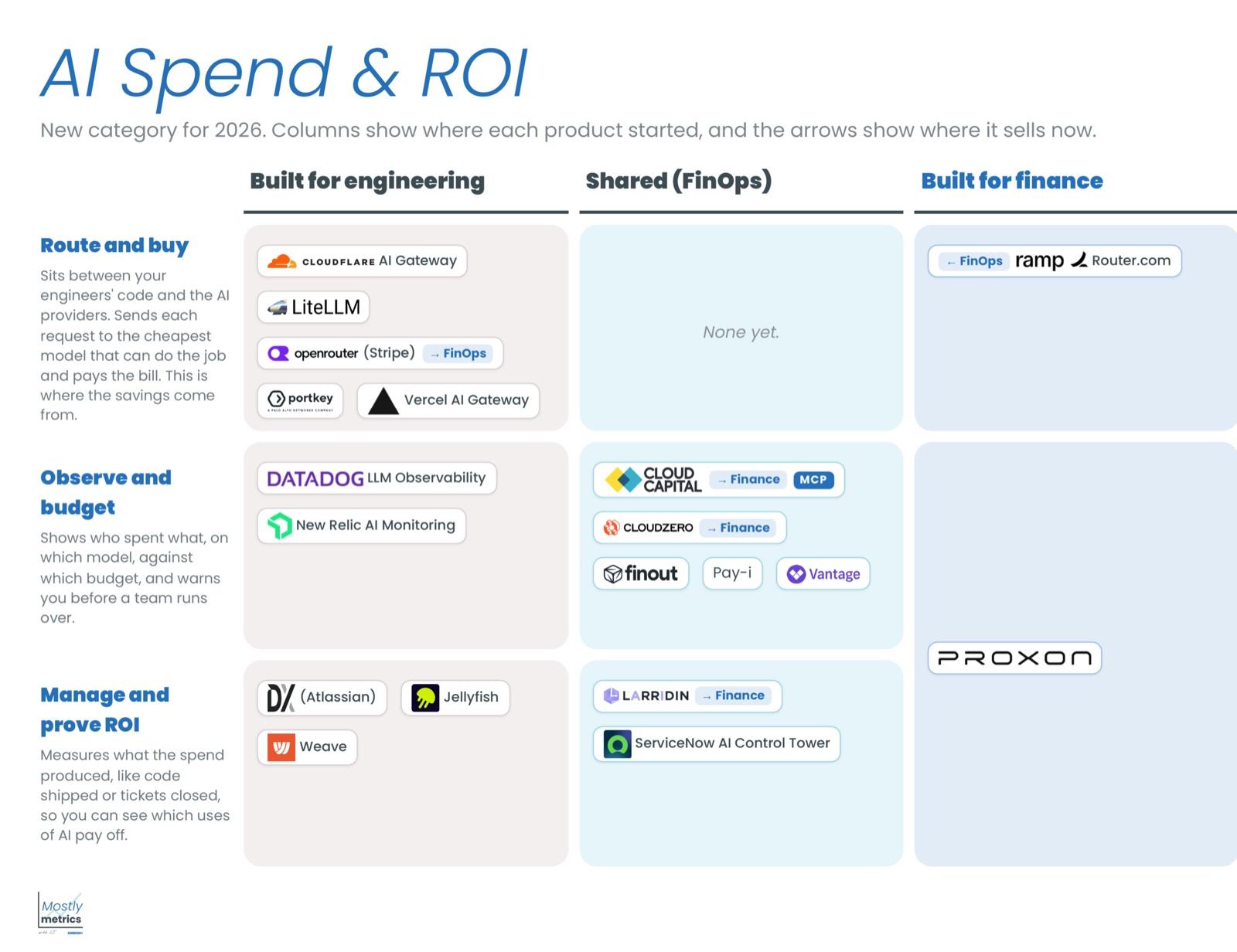
We Learned This the Hard Way
In the last 90 days, 96% of our merged work at Proxon was AI-assisted. We use AI about as heavily as a team can, and until we first pointed Proxon at ourselves a few months ago, we couldn't have told you what it cost or where it went.
That's the part I'd like every CFO to hear. Heavy AI use isn't the problem. Not being able to see it is. Once you can see it, you can aim it.
Three Things You Can't See
1. What You Spend
Spend is scattered across invoices, seat licenses, API accounts, and AI built into other software. Each vendor's console shows you that vendor, and no vendor has a reason to show you how to spend less with them.
So it all lands in OpEx, because nobody can tell what belongs in COGS. AI inside your product leans COGS. AI your people use for notes, documents, and strategy leans OpEx. If finance can't split the two, it can't defend the margin.
| Where it hides | What it looks like | Who sees it today |
|---|---|---|
| Seat licenses | Per-person plans for chat and coding tools | IT |
| API usage | Keys and cloud accounts, billed per token | Engineering |
| AI built into other apps | Features inside software your people already use | The app's vendor |
| Agents | Software that does work on its own | The team that built it |
| The invoice | One total, no owner, no results | Finance |
2. Who Is Using It, and How Well
Seats are easy to count. Use is hard. Two people can hold the same license, and one of them gets ten times the work out of it. You are paying the same for both.
You can't spread what your best people do if you can't see it. And you can't cancel the seats nobody touches if you can't find them.
3. What It Produced
A cost is half a number. The other half is what you got for it: tickets closed, code shipped, deals won, things the business already measures.
That is the only way to answer the $400K question. Put the spend next to the output and let a person decide. It's evidence, not proof that AI caused the result, and anyone who tells you otherwise is selling something.
When You Can See It, You Go Faster
Seeing isn't the goal. Speed is. Three things change the day you can see your AI spend, use, and results:
- You say yes faster. A $400K bet isn't scary when you can watch it as it happens and see what it produced. You can approve bigger experiments, because you can tell quickly which ones are working.
- You move money faster. Put more behind the teams and agents that deliver. Pull back from the ones that don't, before the quarter ends instead of after.
- You spread what works faster. Your best AI users are already doing something different. Once you can see it, everyone else can copy it.
Then a Harder Question: Who Answers When an Agent Gets It Wrong?
In research from Avalara, 92% of CFOs and senior finance staff said they feel pressure to show AI ROI, and 23% said no one, or it's unclear who, would answer for an AI error (CFO Dive).
That's the other side of the same blindness. When we hand important decisions to AI, someone still has to own the outcome. You want to know who that is before something goes wrong, not after.
What Finance Does Now
You don't put brakes on a car so you can stop. You put them on so you can go faster.
That's the job. Finance isn't there to slow AI down. Finance is there to make it safe to put more of it to work, by treating AI the way it already treats headcount: every team and every agent gets an owner, a budget, and a review.
The companies that get this right won't just save money. They'll spend more on AI, on purpose, because they'll know it pays.
Start This Week
- Get one number. Total AI spend last month, across every vendor and every seat. It will be wrong. Write it down anyway.
- Name an owner for every line. If no one owns a line, that's your first finding.
- Split product from internal. Mark what powers your product and what your people use. That is your COGS and OpEx conversation.
- Put your three biggest lines next to what they produced. One result per line is enough.
- Review it monthly, the same way you review headcount.
To see where the market is heading, read the report: the report. To see how blind you are, book a demo and we'll show you on your own data: proxon.ai/demo.
Back to the $400K
So, fire them or promote them?
You should be able to answer that in an afternoon. When you can, AI spend stops being a risk to contain and becomes the fastest way to grow. If you can't yet, you now have a measure of how blind you are and five things to fix first. The companies that fix them first will move faster than everyone else.
FAQ
What does AI-blind mean?
It means you spend on AI across seats, APIs, and built-in features, but no one can give you one total, an owner for each line, or the results it produced.
How do I measure how blind I am?
Take the five-question test above. Three or more "no" answers means you are AI-blind.
Is a big AI bill a bad sign?
No. A large bill can be the best investment you make. It is a bad sign only when no one can say what it bought.
Who should own AI spend?
Someone has to. In most companies engineering owns the APIs, IT owns the seats, and finance sees the invoices. Pick one accountable owner per line, and let FP&A track it day to day.
Does this mean monitoring employees?
No. The goal is to manage spend and return, not to watch individuals.
About Proxon
Proxon helps finance and engineering leaders see what their company spends on AI, who is using it, and what it produces.
Related Reading
- How to Read the AI Spend & ROI Market Map, and What It Means for Your Finance Team
- The State of the Agentic Financial Stack, Mostly Media
- AI Spend & ROI for finance
About the author

Peter Pezaris is the co-founder and CEO of Proxon, which measures the impact of AI on how teams work. He has spent 30 years building software for how teams collaborate, and today leads an AI-native engineering team where agents write and review nearly all the code. Before Proxon, he was Chief Design and Strategy Officer at New Relic, which acquired his developer collaboration company CodeStream (YC W18). He also founded Glip, a team messaging platform acquired by RingCentral (NYSE: RNG) in 2015, and he worked at RingCentral after the acquisition; Multiply, a social commerce platform acquired by Naspers in 2010; and Commissioner.com, one of the first online fantasy sports platforms, acquired by CBS in 1999. He holds a BS in Applied Mathematics and Computer Science from Carnegie Mellon University. LinkedIn · X
Research referenced in this post.
- The State of the Agentic Financial Stack — Mostly Media, Nov 17, 2026
- CFO Dive: 92% of CFOs, top finance staff feel pressure to show AI ROI (Avalara)
- How to Read the AI Spend & ROI Market Map, and What It Means for Your Finance Team (Bri) — Companion post, Nov 17, 2026