

Reading adoption data
How to read the Adoption view, from who uses AI to how skilled they are.
The Adoption view shows how AI is taking hold across your organization. It reads as a story: who is using AI, how often, on which tools, and how skilled they have become. Open Adoption in Proxon to see it.
The adoption signals
The top of the view answers the basic questions at a glance:
- Active Employees: how many people use AI in a given month.
- Usage Frequency: how much they use it.
- Top AI Tools: which AI tools your organization actually uses, so you can see what has spread and spot tools you did not know were in use.
AI Skill Levels
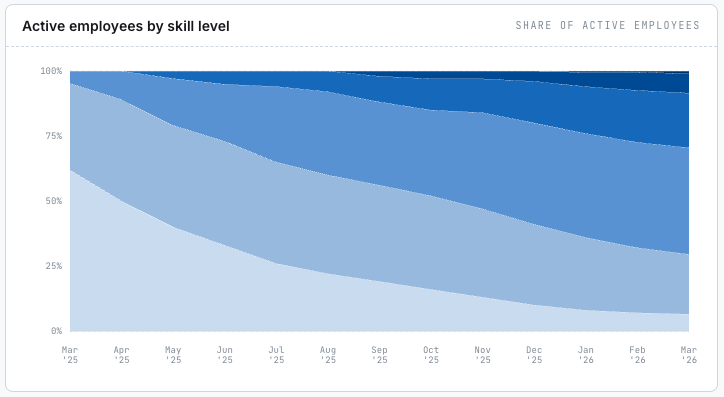
Adoption is not only how much AI gets used, but how well. Proxon places each active person on a six-step skill ladder, from first safe use to running AI as a system that improves itself:
- L0 New: knows what work is safe for AI, what data should stay out, and which starter tasks are useful.
- L1 Chat: uses AI as a conversational helper for summarizing, drafting, rewriting, and explaining.
- L2 Contextual Work: brings files, repos, docs, or project context into the session so AI can make bounded changes.
- L3 Orchestrate: splits work across researcher, drafter, critic, and reviewer roles before final human approval.
- L4 Automate: turns repeated AI work into governed workflows with triggers, permissions, and approval gates.
- L5 Loop: feeds outcomes, exceptions, and human feedback back into memory so every run improves the next.
The chart shows each level as a band, from L0 at the lightest to L5 at the darkest, and each band is that level's share of active employees. Read it over time. As the mix shifts toward the darker bands, your people are climbing the ladder. A population stuck in the lower bands is where coaching pays off most.
Who to learn from and who to help
Further down, the view calls out your top adopters, the people to learn from and hold up as examples, and the people who are lagging, who have either not started or have stalled. Pair the two. Take what your strongest users do, and bring it to the people who need it.